
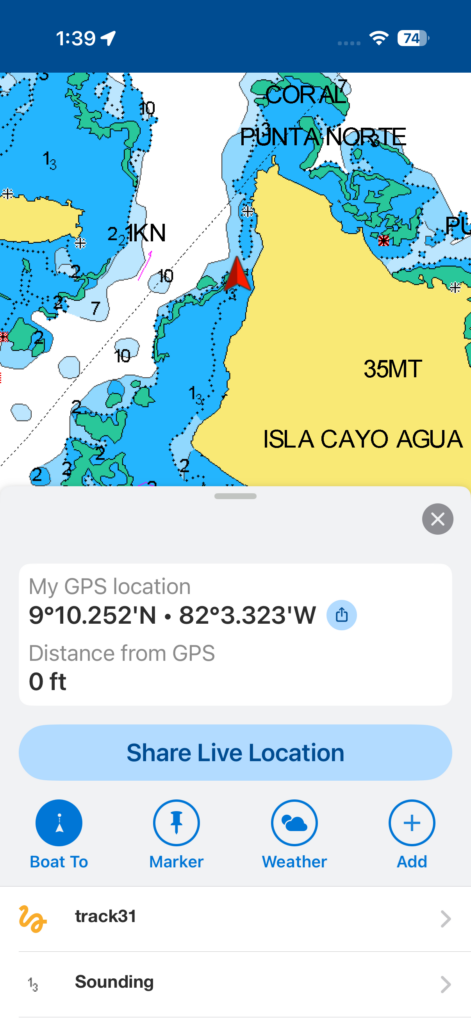
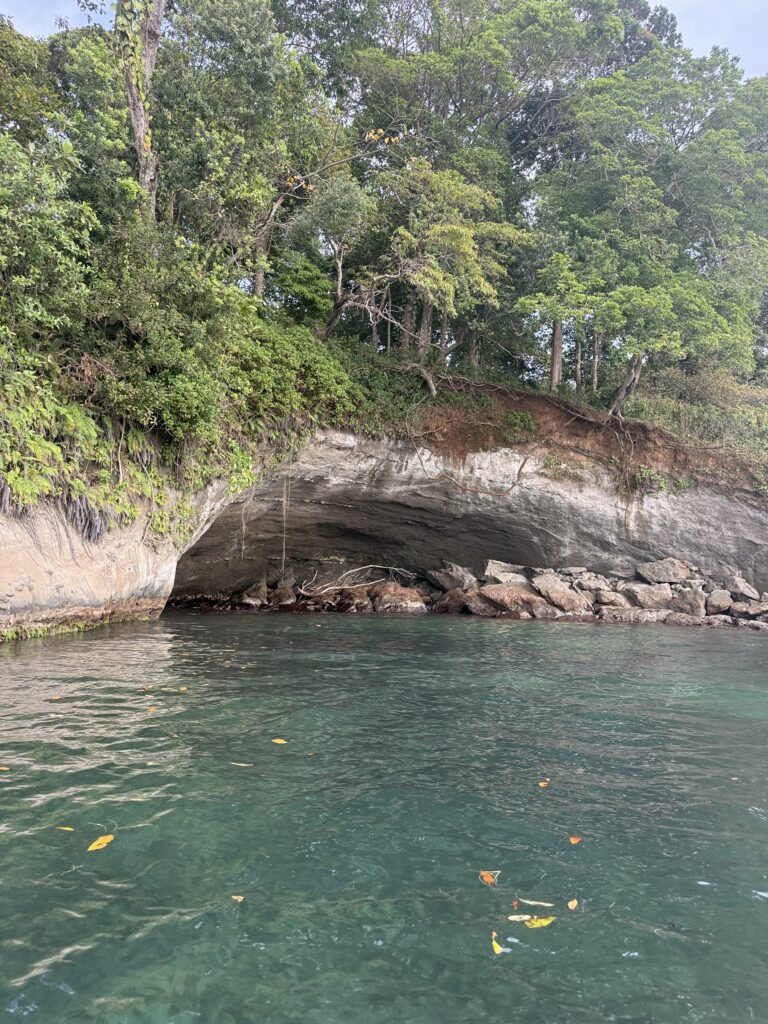
Galini has spent the past several days anchored off the northern shore of Isla Agua in the Bocas del Toro region of Panama. Here, we have a different landscape than the mangrove patches the line the region on the other side of the Crawl Cay pass, where we spent the previous several weeks. Isla Agua is close to an opening into the Caribbean sea, between the tip of Valiente Peninsula to the SE and Isla Bastimentos to the NE. The winds have been light to absent, so little swell from the sea has been sweeping in so the anchorage is flat and pleasant. This makes for wonderful snorkeling and restful night sleeping. There is a small outcropping of Ngabe villager homes at the western edge of the island near us and we see them in their dugout canoes free diving for fish and lobster in the reefs all around us. The island is forested. Ken and Sandra have found an open area on a hillside that is a short hike away from the beach with trees and bushes ripe with berries draw in birds of many types. They are spending both mornings and evenings traversing the area for bird watching and photography. It has been quite warm in the early afternoons, hot actually, but cools off around 4pm and the nights are pleasant. With little wind, the temperature swings have been less dramatic, so a swim each day is a pleasant escape. Typically, my swims have been a snorkeling adventure and the northern tip of the island just a short dingy ride away has rock formations with a large array of fish and corral alike. Yesterday, at the end of my snorkel outing with Ken, I came across a large sand patch in-between sea grass beds, with four Southern Rays swimming together. The animals would swim a few feet, then stop and sweep their large ray tips across the sand beneath them, digging a few inches into the substrate. Sand and silt were swirling over their perimeters during the movements, and curious smaller fish would hastily dart through the swirl as the rays pulsed their pectoral fin tips up and down. This behavior went on for tens of minutes. At one point, I saw two rays performing this behavior with partially overlapping bodies, which made me think I was witnessing stingray sex. But then I realized that the animals were actually feeding, using a behavior called benthic suction or excavation, where they swing the fins into the sand creating a vacuum underneath the body to suck pray into their mouth. A stingray’s mouth is lined with cartilage plates to crush the mollusks, crustaceans, fish, and worms upon which they feed. This was the first time I had witnessed these wonderful animals in their own world feeding and it was a delight.
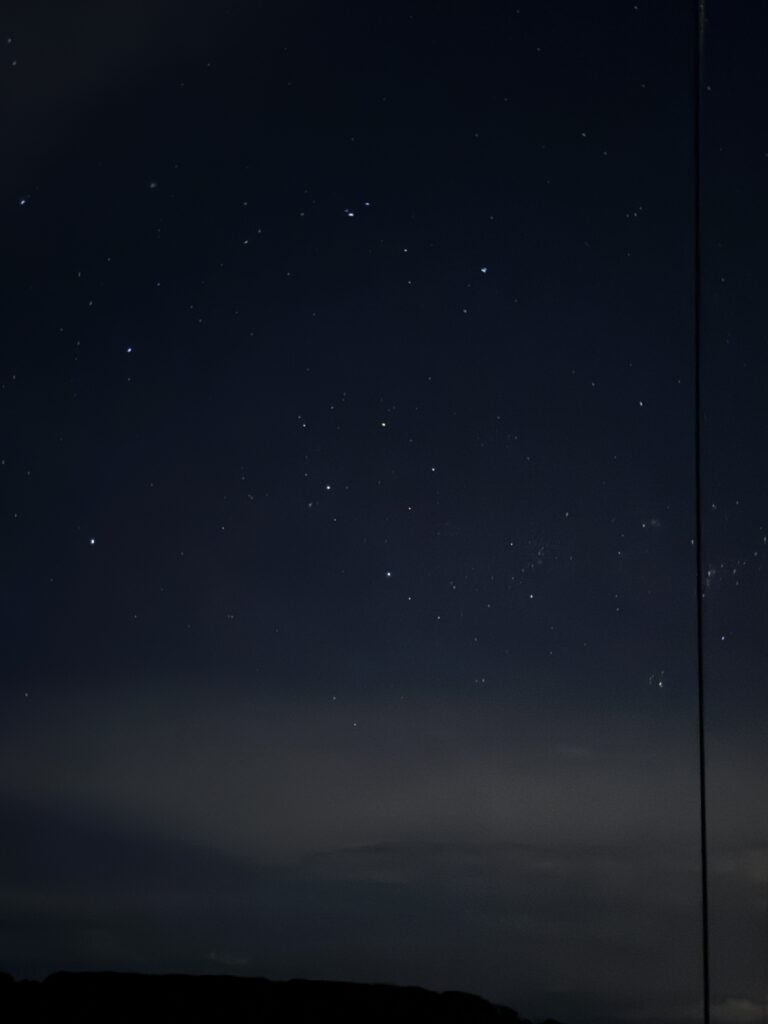
In the evenings, the water has been very still, with little wind and as the sun sets, parrots by the dozens, flying in pairs return to their homes here. The pass over Galini, mostly from the northern reaches of Isla Bastimentos. Curious how they feed north in the day and return to their nests here on Isla Agua in the evening, but adaptation to the changing environment is a hallmark of nature. The skies at night here are wonderful. There is little light pollution as the only town of Bocas is nearly 20nm to the NW and hidden from us by the intervening islands and mangrove marshes. The moon is approaching full now, a waxing Gibbous, but rises early before dark and sets around 3 am, so there is plenty of sky free for star viewing. Last night, just before I went to sleep, I was laying out on the deck at saw the Southern Cross, prominent in the night sky, low to the NW horizon. I felt lucky to be here in this moment, and I was filled with a comfort in the knowledge of understanding now, why I came this way.
Amazing!! Glad you’re having such a great voyage!
Looks beautiful David!