
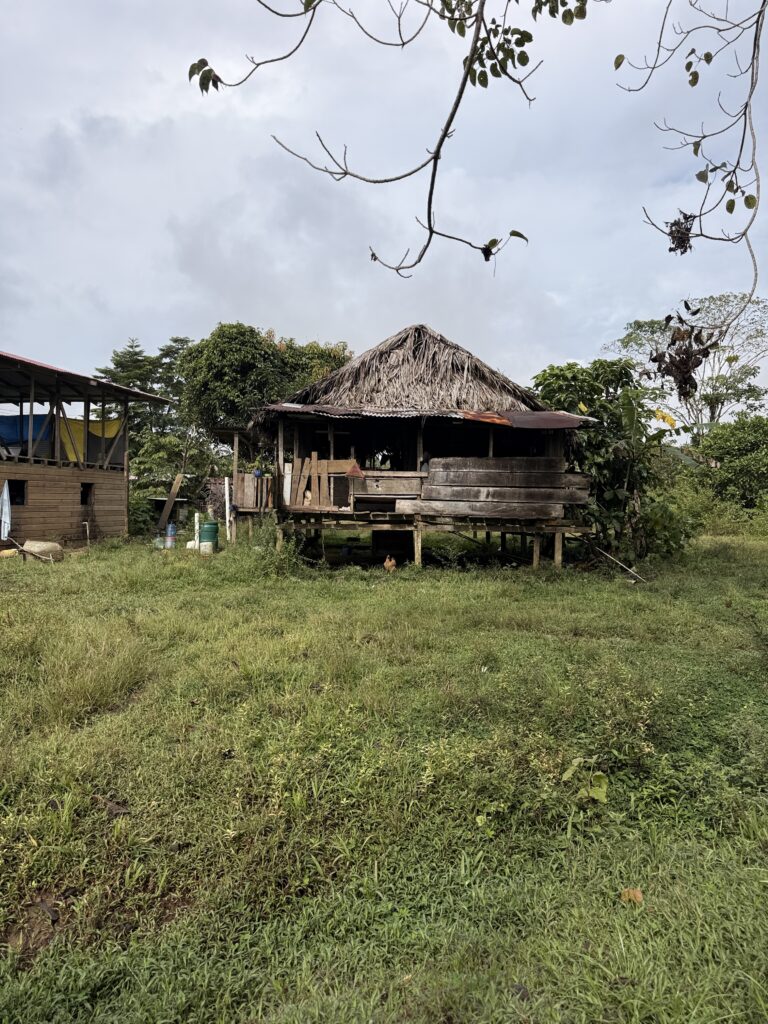
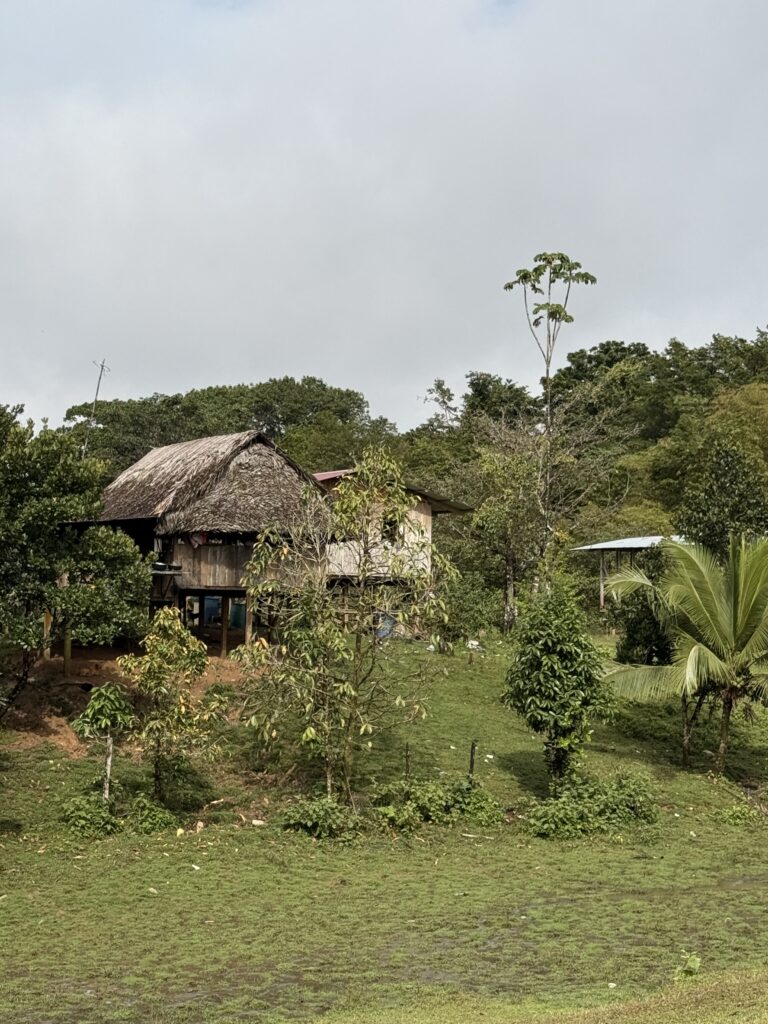
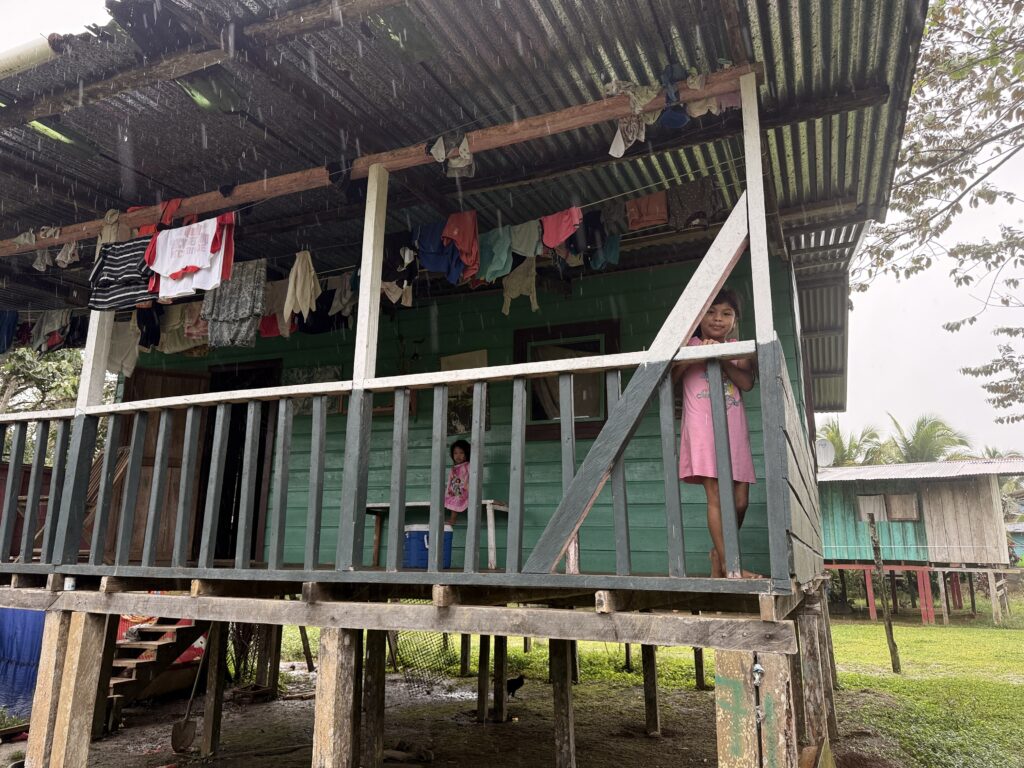
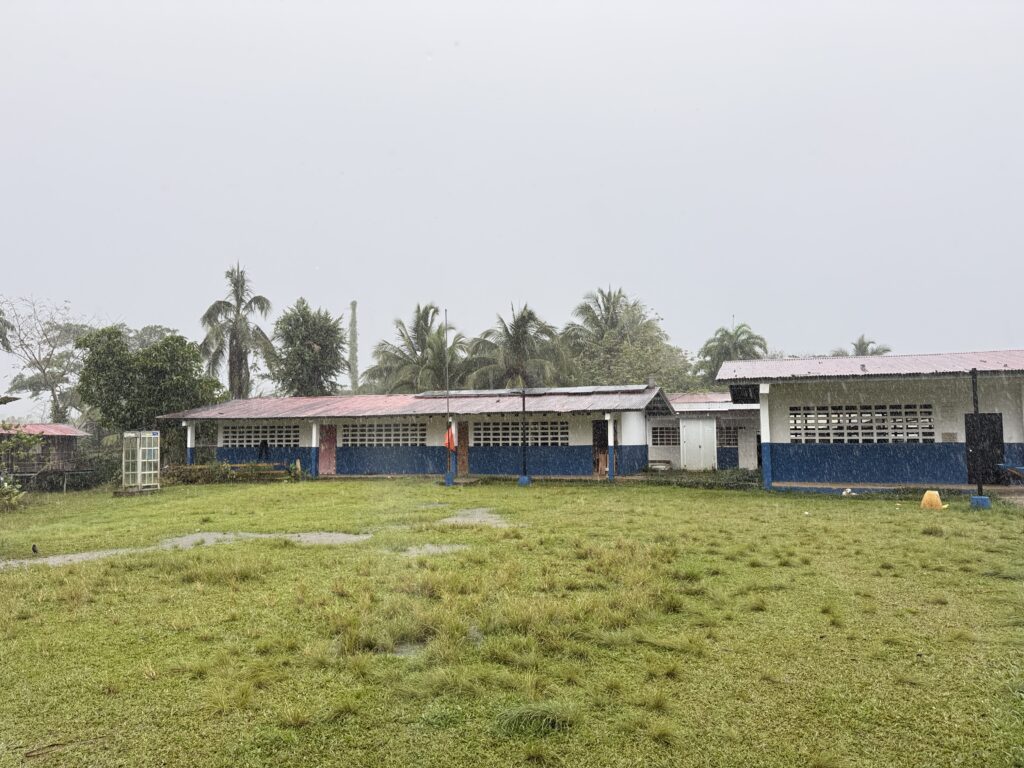
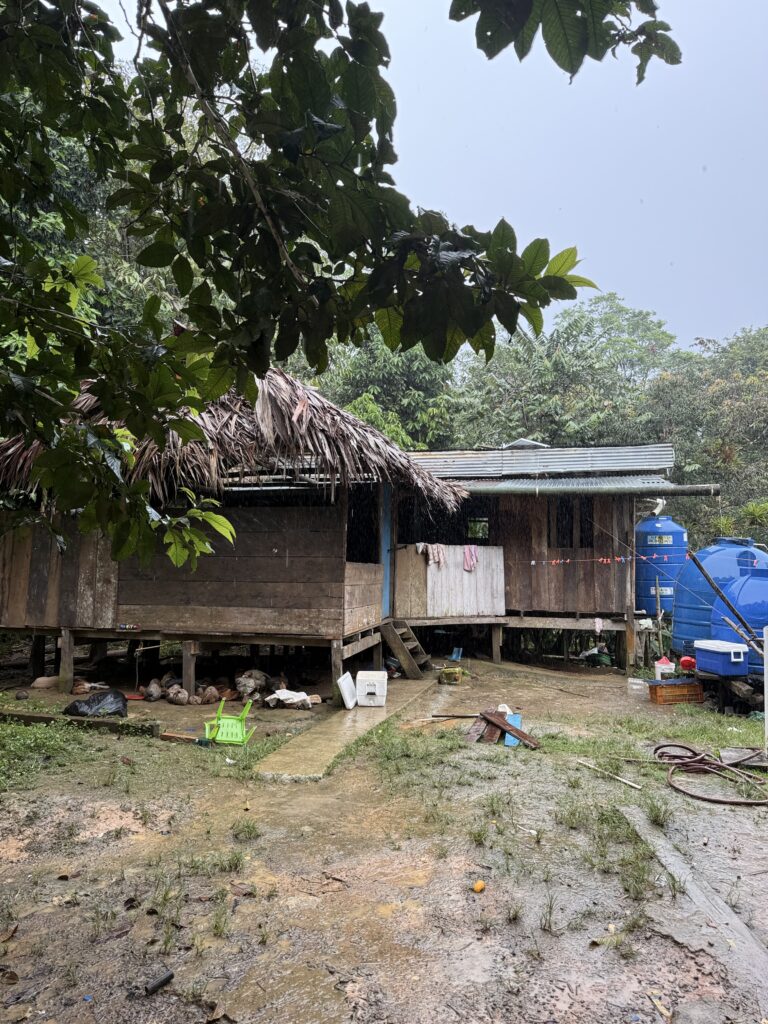
Rain started our morning here lying off the southeastern coast of Isla Bastimentos, near the Punta Patino. A lovely spot, nestled between two coral reefs that stretch up and down the shore; patches or sea life that stud the waters of these islands. There are several small eco resorts nearby, but mostly vast stretches of unspoiled jungle fill the land. We took our dinghy to meet a local man, Calypso, who was to be our guide for the morning to introduce us to his village, Quebrado Sol, inhabited by the native Ngäbe Bugle people, followed by a jungle wildlife tour. We picked up Calypso off a small dock on shore and took the short jaunt down the coast to the entrance of Salt Creek, nestled in the massive mangroves. We motored up the creek and entered a canopy of mangroves, covering the creek like a cave of dense leaves, twisted chaotic trunk roots jutting from the water and thrusting to the sky. The mangrove cave was thick, and shielded the light from above, with the rain dripping through the forest ceiling. We wove up the creek for a ways until a long dock appeared, with several brightly painted pangas moored. Calypso guided us up a small concrete path and we entered the village. A larger structure at the outset, which served as a meeting place for visitors and a trade store. Here, the concrete ended, as did the mangrove forest, so we walked along a dirt path, muddied now by the rain, as the vista opened into small hills and valleys with village homes strewn along the way. Often, bits of wood plank were thrown crossways along the path, sometimes lengthways, to aid in walking through the thickened mud. It is rainforest after all. Calypso explained that the Nägbe are one of the five different indigenous people in Panama. His village, here at Salt Creek, ad 1200 people, with nearly 150 homes. The homes were small, all elevated off the terrain by wooden piers of nearly 8 feet in height. All the homes were open air structures, some with thatched roofs, but many had corrugated metal instead. It was interesting mixture of cultures, wooden homes, with cloth or beaded doorways, open air windows, large cisterns on the side or rear that was fed rainwater runoff from a plastic pipe cut along the edge of the roof. Today, it was raining, as had been the case for the vast amount of the last couple of months, so all of cisterns were overflowing spilling the fresh rain runoff onto the ground. Many homes had children on the porch, or watching us from windows as we passed. Calypso explained that the children were on winter recess for three months. In the center of the village, was the school that provides education for all children from 1 – 6th grade, then continues on to 12th for some kids. Most families have 6 – 7 children on average. Next to the school, there was a large field that had a baseball backstop, made of wood and wire, as well as soccer goals, which served for all sports for the village. We stopped for a moment, as the rain intensified, in a large open covered structure, with a concrete floor and an elevated stage at one end. This was the music hall, dance hall, meeting hall. Calypso explained that there were three religions actively practiced, catholic, Baptist, and light of the world. Most of the adults of the village found occupation in modern times working at the resorts a short distance away, or would travel by panga each day to Bocas town for work, or were fishermen. Some of the woman made jewelry or baked goods for sale to tourists. There are no taxes assessed to villagers for the local government. Instead, tourist fees, currently $10/person, as well as proceeds from jewelry, carvings, and other local crafts sales support the community.
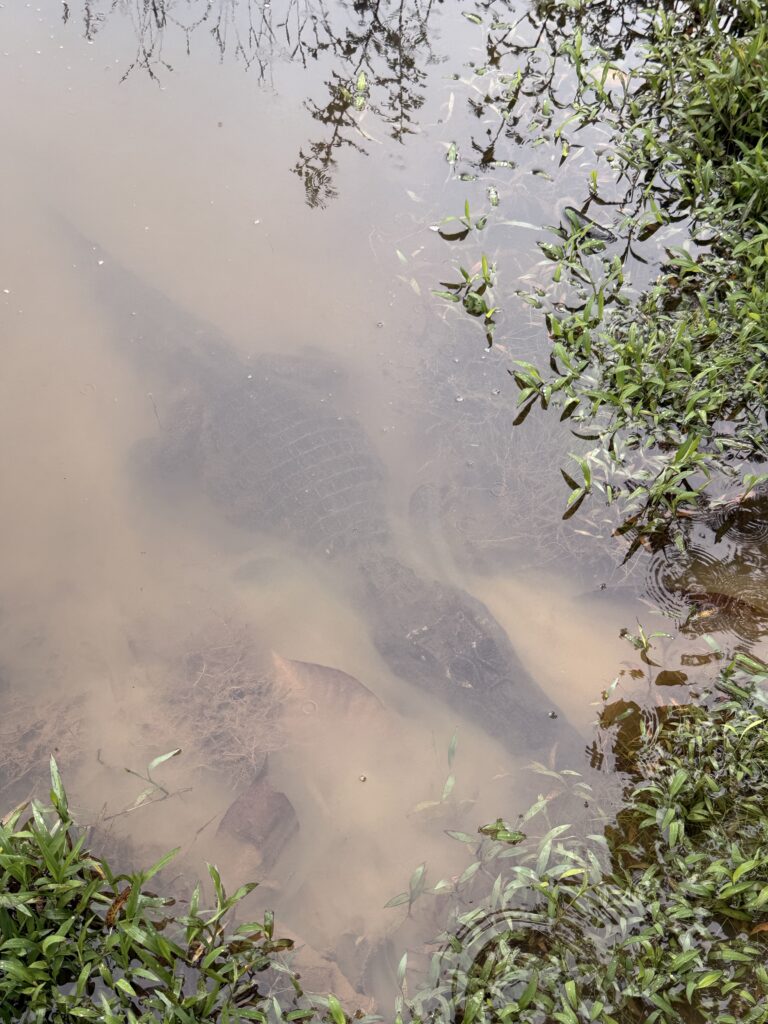
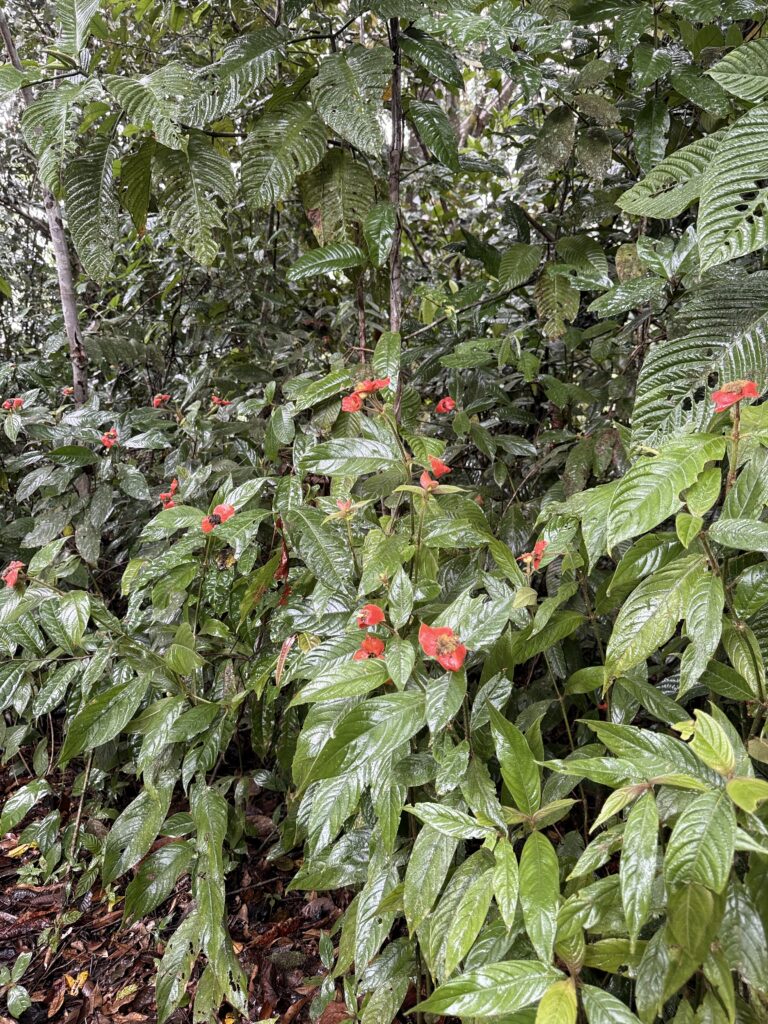
The rain subsided to a small mist, so we continued on through the village outskirts, with homes dotted along the path, crossed several small creeks with logs or wood planks serving as step bridges, then into a large pasture with a wooded fence. Here, there were several cows and a horse. Up and over a small hill, then down again to a pond surrounded by small trees, wild flowers, hibiscus, and lush green shrubs. We stopped. Calypso showed us bubbles near the shore of the pond and stated that was a cayman. Then, he proceeded to whistle a simple jingle, repeated over several times and the bubbles began to move toward us. After a few seconds, the cayman, around 3 feet in length surfaced and lodged his head and body at the waters edge in front of our pied piper guide. It was amazing, Calypso told us that there was a mating pair of caymans in the pond, nearly five years old, with 2 young offspring less than a year old. He said their diet consisted of young wild chickens and wayward dogs. We moved on, crossed a few fences and entered into the jungle at the edge of the village. Here we climbed through the jungle path, all mud, with tree roots and occasional bamboo poles cut and placed into the path for footing by the locals. Calypso showed us several medicinal plants, one called burning flower, a bright red bulbus budding flower measuring around 5 centimeters across on a large green leaf bush, that is boiled and used as an analgesic. Another long green leaf stalking plant, with no wooded branches, is cut, then fibrous strips of the leaves are pulled into threads that can be used for weaving. Quite strong, Calypso explained. We continued. No mangroves here, but large trunk trees, hanging wooded vines strewn from their branches, and lush green undergrowth, thick and varied in hues of green. We stopped along the path and Calypso directed our attention to up a large tree trunk with several wooded vines wrapped around, to a large hole in the trunk about 10 meters off the ground. Calypso took a banana out of his backpack and attached it to a bamboo pole that lay next to the trail, then held it up to the tree next to the hole. Out emerged a night monkey, who welcomed the banana treat and sat outside on the stoop of his home devouring the fruit for us to watch. There are two species of night monkey, the brown face and the white face. This one was a brown face. Clearly, this monkey had a permanent home that Calypso knew well. The night monkeys get their name due to their foraging habits of feeding and traveling along the canopy at night, resting in the day.
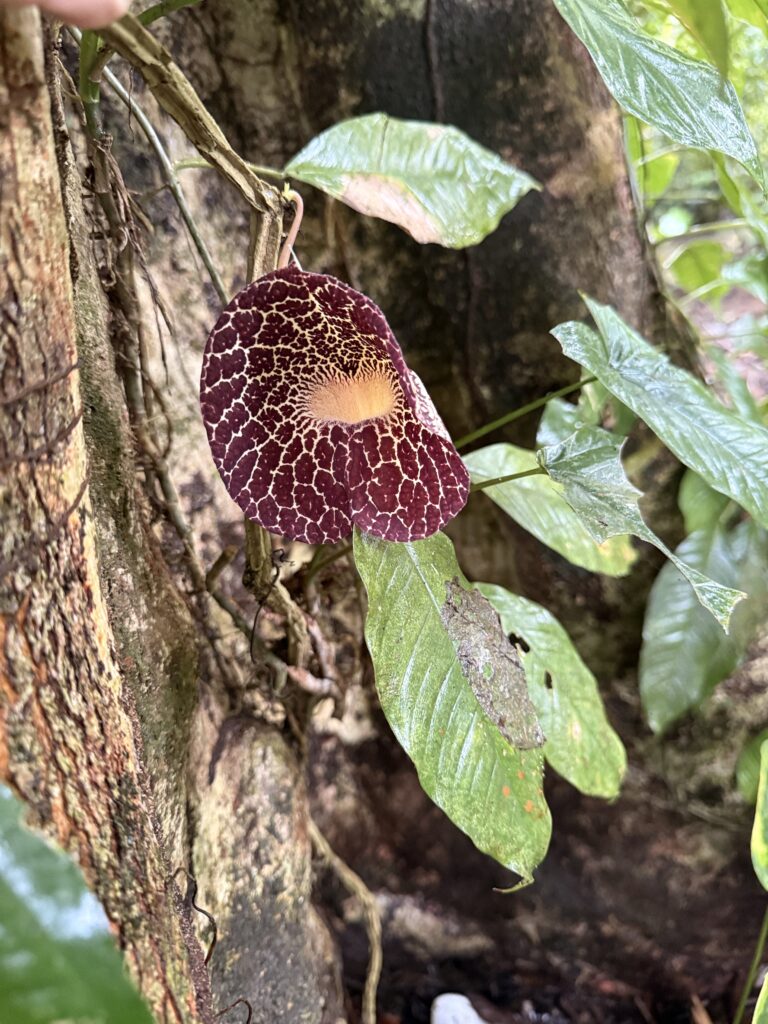
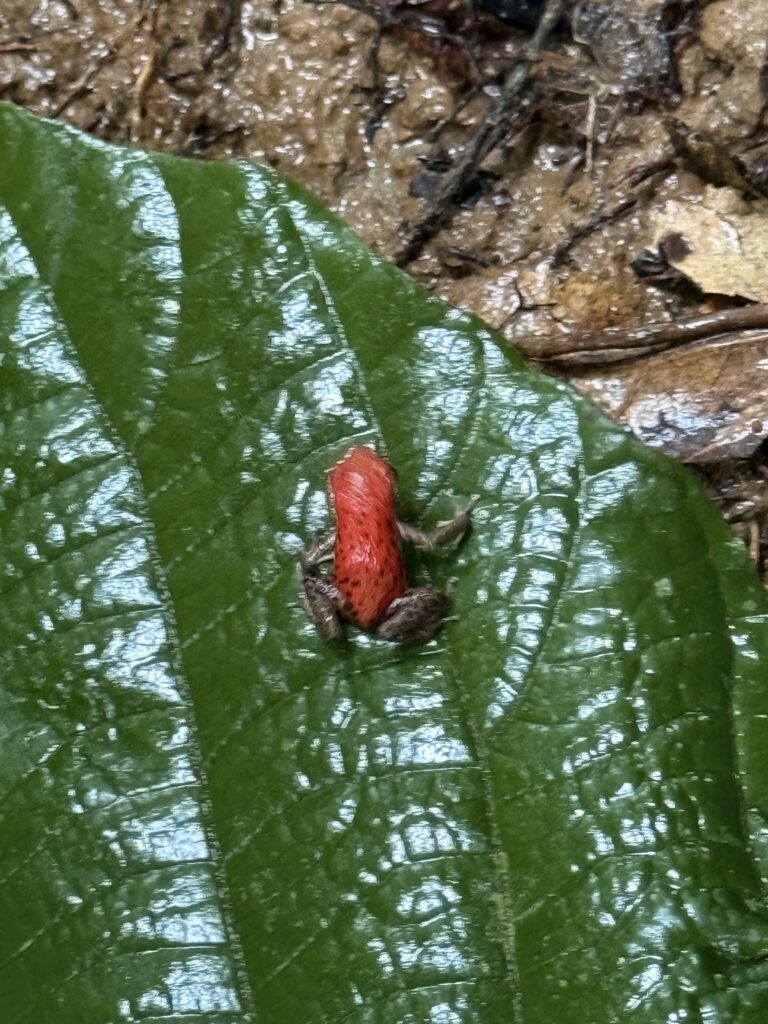
We moved on, up and down small hills, being shown the local fauna. I was struck at the number of flowering plant species in the jungle. White, blue, red, and yellow, some on vines, others in bushes, but the density of the green jungle, the hanging vines from the trees, the ever present mist and rain dripping from the canopy was mesmerizing. Next, we stopped. Calypso went up the trail a bit and asked us to wait, only to return with a tine red frog in his hands. This was one of the poison tree frog species, one with no spots. The small creature was bright red with large black eyes, being only a centimeter in length. Wonderful. Calypso explained that the toxin was concentrated inside the animal, although the skin could offer some poison if handled aggressively.
We could hear the rain subsiding in the forest canopy and it was time to return. We emerged from the jungle and retraced our steps across the pasture and back into the village, but this time went to the north side where a new church was being built. As we walked, more people were met along the path, many young children, all greeting us with “Hola” and a smile. Different from anything else in the village, this was a large structure, made of steel and aluminum. Inside, was a modern design, with light fixtures, stucco walls, glass windows, a stage and a pulpit. There were two women at the front singing in prayer in Spanish. Lovely voices. This was a church being built with proceeds from village craft sales, donations, and monies from the international Light of The World denomination. An amazing stark contrast to the homes and other community structures that comprised the village. We shopped in the church store located next door, bought some beautiful friendship bracelets, chatted with some of the local people, then moved on back to leave. As we walked down the path to our boat, I saw another structure with windows, solar panels, and a locked door. This was the doctor clinic. An American doctor comes to the village every three months, and stays for several days to treat the local people. As we continued, I also noticed two homes with satellite antennas, Starlink, actually, showing the far reach of modern technology even in these most unexpected places where humanity thrives.
Finally, we returned to our starting point, paid our tourist fee at the government building, signed the visitor’s log, and said our goodbyes to Calypso. I thanked him sincerely, and stated how grateful I was to learn of his village, his people, the forest, and the island culture that has existed here for many generations.
Sounds wonderful! So sorry to have missed this experience!